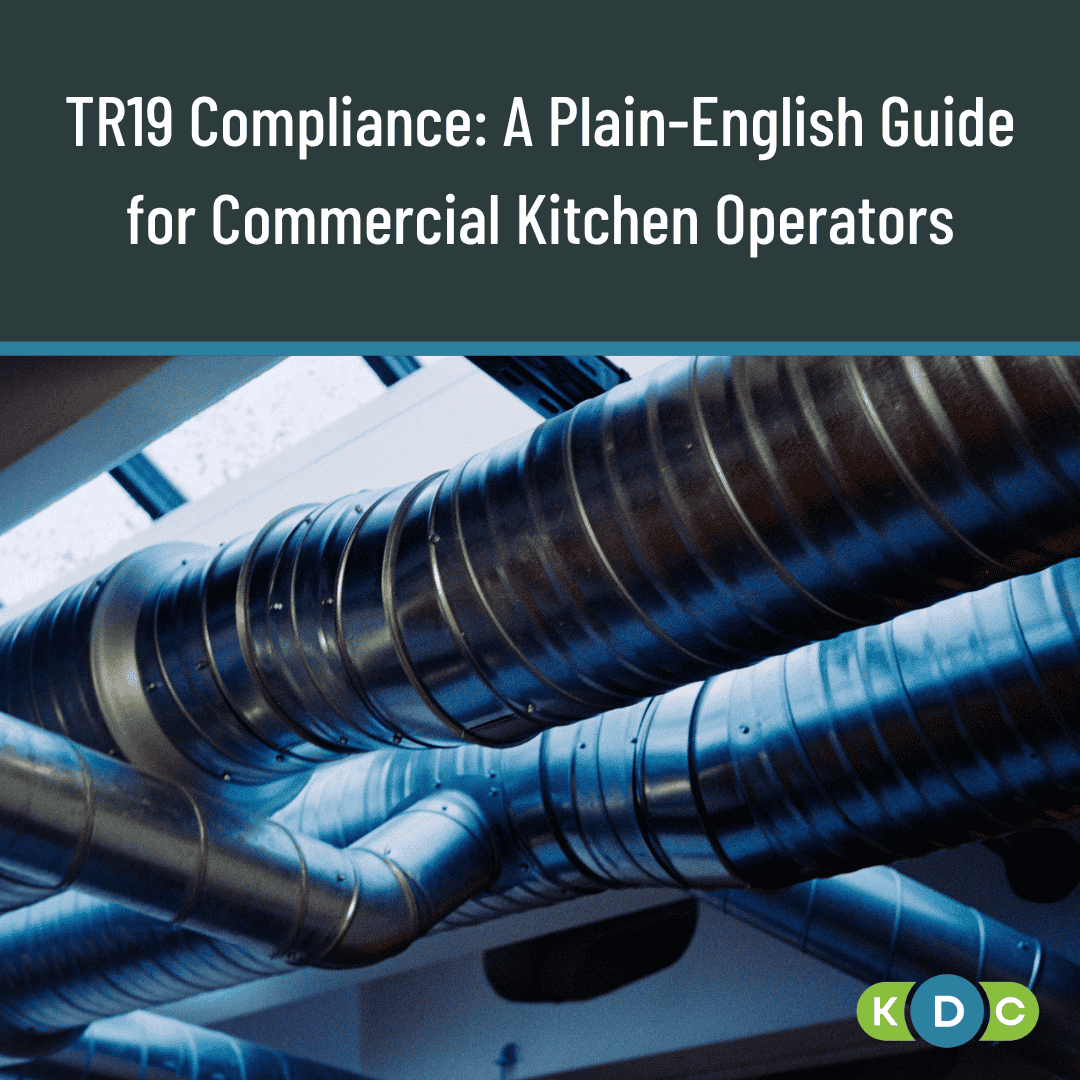


TR19-Compliant Kitchen Extraction Cleaning Explained
An overview of the TR19® Grease standard for commercial kitchen extraction cleaning, explaining the fire risks of grease build-up, legal and insurance implications, the TR19 cleaning process and frequencies, required certification, and how KDC Food Hygiene Ltd can help ensure compliance.
There’s something lurking in your kitchen that you probably can’t see, yet it’s a lot more dangerous than a dodgy prawn. Inside your extraction ducts, grease is quietly building up every single service, every single day.
Left unchecked, it turns your ventilation system into a fire waiting to happen. For any commercial kitchen – whether you’re running a bustling hotel restaurant, a hospital canteen, or a school kitchen – TR19® Grease kitchen extraction cleaning is the standard that keeps your kitchen, your staff and your business safe. Read on to learn more…
What is TR19® grease?
TR19® Grease is a set of industry guidelines issued by BESA, the Building Engineering Services Association. Think of it as the rulebook for keeping commercial kitchen extraction systems free from dangerous grease build-up. (TR19® Air, meanwhile, relates to dust, allergens and air quality in ventilation ducts, which is not the focus of this blog.)
TR19® Grease started life as a best practice guide, but it’s since grown into a rigorous, standalone cleaning standard applied right across the UK. Today, TR19® Grease sets out exactly how extraction systems should be inspected, cleaned and verified; from the canopy above your hobs all the way through to the terminal fan on the roof.
What makes it different from a regular clean? It’s specific and measurable. It’s also the benchmark that insurers, fire inspectors and environmental health officers (EHOs) now expect to see met. If your cleaning company can’t clean to TR19 standards, they’re not the right company for the job.
The fire risks of ignoring kitchen extraction
Did you know that many commercial kitchen fires start because of grease build-up in ventilation and ducting?
Fat and grease accumulation is one of the biggest fire hazards in commercial catering. A thin layer of dried grease inside your ductwork acts like a fuse. Once it catches, fire can travel through the duct system at speed, spreading to other parts of the building before anyone’s even reached for the extinguisher. Scary stuff…
The thing is, grease deposits don’t build up overnight, making them easy to ignore. They’re out of sight, so out of mind. But excessive grease in your extraction system is quietly raising your fire risk every day that you don’t deal with it. We’ve seen kitchen ductwork that looked less like ventilation and more like the inside of a chip pan that’s never been emptied, which is genuinely dangerous.
Don’t wait for the smoke alarms to tell you what the grease already knows. Stay on top of having your extraction system professionally cleared of grease.
Important legal, health and insurance implications
TR19 compliance isn’t just good housekeeping; it’s a legal requirement. Under the Regulatory Reform (Fire Safety) Order of 2005, business owners are responsible for managing fire risks on their premises. That includes keeping kitchen extraction systems clean.
This applies whether you’re running a stadium kitchen, a care home, a fancy hotel restaurant or a takeaway on the high street. If something goes wrong and your extraction hasn’t been cleaned to the required standard, the consequences can be serious:
- Your insurer can (and likely will) invalidate your claim in the event of a fire.
- An EHO can issue fines or improvement notices.
- In the worst cases, you can face a closure order.
There's a health angle, too. A neglected ventilation system circulates stale, contaminated air through your kitchen. For your kitchen team working long shifts in an enclosed space, that matters. Staying compliant with TR19 isn’t only about fire safety regulations. It’s about the wellbeing of the people who show up every day to keep your kitchen moving.
The TR19 cleaning process explained
So what actually happens when a professional team comes in to do the job properly? It’s a fair bit more involved than a wipe-down and a quick hoover.
A full TR19 extraction clean covers the entire kitchen extract system from end to end, including:
- Canopy and plenum: The collection hood above your cooking equipment is cleaned inside and out, removing surface grease and carbon deposits.
- Filters: Grease filters are removed, degreased and either cleaned or replaced depending on their condition.
- Internal ductwork: This is where most of the graft happens; access panels are installed at set intervals so the team can get inside the duct system and work through it properly.
- Fans and dampers: Fan blades are cleaned individually; dampers are checked and cleared.
Mechanical scrapers and specialist degreasers are used to shift the heavy grease deposits. It’s not a quick job – and it shouldn’t be. Any cleaning company telling you they can do a full commercial kitchen extraction clean in under an hour should be looked at sideways.
The key metric
After cleaning, the grease residue on the internal surfaces must measure less than 50 micrometres (microns). That figure isn’t arbitrary. It’s the point below which grease ceases to be a meaningful fire risk. A proper cleaning company will carry out Deposit Thickness Testing (DTT) to confirm that the target has been hit.
How often should your kitchen extraction be cleaned?
This is where a lot of kitchen operators get caught out. BESA sets cleaning frequencies based on how many hours a day your kitchen is in use.
Here’s how it breaks down:
- Heavy use (12 to 16+ hours a day): every 3 months; think busy fast-food outlets or hotel kitchens running breakfast through to late-night service.
- Moderate use (six to 12 hours a day): every 6 months; think a mid-sized restaurant or pub kitchen.
- Light use (two to six hours a day): annually; think a small school canteen or occasional-use kitchen.
Facility managers sometimes assume a once-a-year clean covers everything. But for a heavy-use kitchen, that’s nowhere near enough. Regular cleaning at the right intervals is what keeps grease levels in check and your fire risk genuinely low, not just on paper.
Not sure which tier you fall into? A decent cleaning company, such as ours, will assess your kitchen and advise you honestly.
The importance of the TR19 certificate
Once the cleaning work is complete, the job isn’t quite finished. A fully TR19-compliant extraction clean comes with formal documentation. Trust us, that paperwork is worth its weight in gold when an inspector comes knocking.
A proper Post-Clean Report (PCR) includes:
- Before-and-after photographs of every section of the duct system.
- DTT (Deposit Thickness Test) readings confirming grease levels are within the required limits.
- The official TR19 certificate confirming that the work has been carried out to the required standard.
This is your proof of due diligence. Hand it to your insurer, your fire inspector, or your EHO, and there’ll be no question about whether the work was done or how well. Without it, you’re essentially taking someone’s word for it, which is not a position you want to be in.
Partner with KDC Food Hygiene Ltd for complete compliance
KDC Food Hygiene Ltd provides TR19-compliant extraction cleaning across London and beyond, covering everything from canopy and duct cleaning to full kitchen extract system cleaning and ventilation hygiene.
We follow BESA’s ‘TR19: Internal Cleanliness of Ventilation Systems’ publication, taking all the necessary steps to minimise the risk of fire through extract cleaning. Our teams are fully accredited, experienced in commercial kitchen environments of all sizes, and will leave you with complete documentation, so you can breathe easy.
Whether you need a one-off deep clean or a regular cleaning schedule to keep on top of compliance, contact KDC Food Hygiene Ltd today for a tailored quote. You do the cooking; we’ll handle the grime.
FAQs
What is TR19 kitchen extraction cleaning?
TR19® Grease is the industry standard set by BESA for cleaning commercial kitchen extraction systems. It covers everything from canopy and filters to internal ductwork and fans, with grease residue tested to below 50 microns.
How often should the kitchen extraction be cleaned?
It depends on usage. Heavy-use kitchens (12+ hours daily) need cleaning every three months. Moderate-use kitchens every six months. Light-use kitchens, such as small school canteens, need an annual clean.
What happens if I don't keep my extraction system TR19 compliant?
Your insurer can invalidate claims, an EHO can issue fines and, in serious cases, you could face a closure order. The Regulatory Reform (Fire Safety) Order 2005 makes this a legal responsibility.
What do I get after a TR19 extraction clean?
You’ll receive a full post-clean report with before-and-after photos, Deposit Thickness Test (DTT) readings confirming grease levels are within limits, and your official TR19 certificate.
Does KDC Food Hygiene Ltd cover London?
Yes. We provide TR19-compliant extraction cleaning across London and the country, covering commercial kitchen ventilation cleaning, canopy and duct cleaning, and full kitchen extract system cleaning with complete documentation.