

Grease in Your Extraction System: The Fire Risk Commercial Kitchens Underestimate
Grease-laden ductwork is the fire hazard hiding above every commercial kitchen. Learn what TR19 extraction cleaning does and why it’s a legal duty.
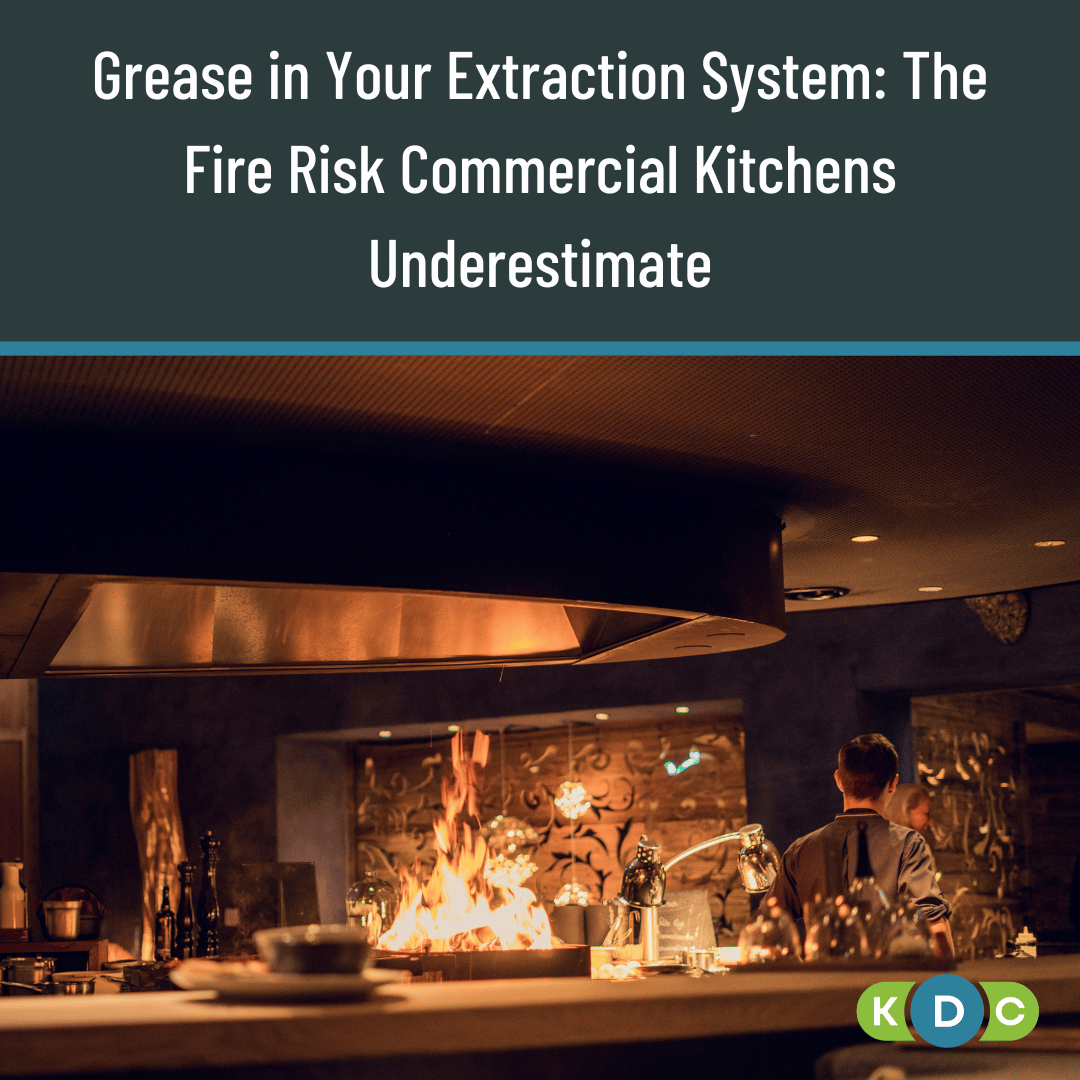
Most commercial kitchen staff make sure that the surfaces are wiped, the floors are mopped, and the hobs are gleaming. But how many people look up and consider what’s out of sight? Hidden inside the ductwork above your head, grease may be quietly building up and hardening, which is a dangerous situation that’s best avoided.
Grease build-up inside kitchen extractions
Grease build-up inside kitchen extractions is widely recognised as one of the leading fire hazards in commercial kitchens. And yet it’s the hazard that busy kitchen managers in restaurants, hotels, hospitals, schools and stadiums are most likely to overlook. This guide is here to ensure that you understand why this is a fire risk that could shut your whole operation down, and empower you to take important action.
The hidden danger: how grease accumulates in ductwork
Grease builds up inside kitchen ductwork every single day, in every commercial kitchen that cooks at high heat. Yet most of it is completely invisible to staff.
Every time a chef fires up the fryer or gets the grill going, high-temperature cooking produces microscopic grease-laden vapours that rise into the air. Your extraction canopy draws those vapours upward, pulling them through the hood and into the filters. The filters only catch some of it. As the air travels further along the ventilation ducts and cools down, the grease condenses and sticks to the internal walls of the ductwork. In time, what started as a light film becomes a thick, sticky, highly flammable layer coating the inside of your extraction set-up.
Why your daily clean doesn’t reach it
The problem is that ductwork runs behind ceilings and walls, out of sight and out of reach. You can wipe the canopy every night and change the filters regularly, which you should, but neither of those things touches the grease accumulation inside the ducts themselves.
There’s a knock-on effect, too. As grease buildup increases, it restricts airflow through the ventilation system, forces extraction fans to work harder than they should, reduces air quality in the kitchen, and creates warm, sticky conditions in which bacteria could thrive. Your extraction is working against you long before any spark appears.
What causes grease fires in commercial kitchens?
Grease deposits inside extraction ductwork are highly flammable. If a flame, electrical fault or another ignition source reaches built-up grease, a fire can spread rapidly through the ductwork. Because the fire is hidden from view, it may travel beyond the kitchen before it’s detected, making it far more difficult to control.
It’s important to know that once the accumulated grease inside the duct ignites, the ductwork itself becomes the problem. It acts like a tunnel, funnelling the flames and letting them spread rapidly and invisibly through the building; bypassing fire compartmentation, creeping into upper floors, and threatening adjoining premises before anyone even knows where it started.
A fire starting from an unclean ducting system isn’t a rare occurrence. In their Fire Safety Guidance Note: Catering Kitchen Extract Systems, the London Fire Brigade state that “by far the most common problem and cause of ducting fires is the lack of proper cleaning and maintenance”.
Why grease duct fires are so hard to fight
A standard kitchen suppression system is designed to tackle a fire at the cooking surface. It won’t necessarily reach one that’s travelling inside the ductwork above. By the time the smoke alarm goes off, a grease duct fire can already have spread to areas of the building that nobody expected. That’s why prevention, not reaction, is the only sensible approach.
The legal and financial consequences of neglect
Under the Regulatory Reform (Fire Safety) Order 2005, there is a named “Responsible Person” for every commercial premises. Usually, this is the kitchen manager, facilities manager or business owner. That person has a strict legal duty to carry out a comprehensive risk assessment, which must cover the kitchen extract system.
The financial risks include potential fines from failed inspections, as well as those related to insurance, as failure to maintain extraction systems may affect insurance claims following a fire. The full cost of the damage, the legal proceedings, and the forced closure could land squarely on the business. There are also potential prosecutions under health and safety legislation, which means Environmental Health Officers (EHOs) can be involved before an incident ever happens.
TR19® grease compliance and cleaning schedules
TR19® Grease is the industry standard specification set by BESA (the Building Engineering Services Association) for managing fire risks in kitchen extraction systems. It sets out exactly how extraction systems should be cleaned, inspected and documented. It’s also what insurers and fire inspectors expect to see.
The recommended cleaning frequency depends on how hard your kitchen works:
- Heavy use (12 to 16 hours per day): fast food operations, large hospitals and high-volume catering should clean every three months.
- Moderate use (six to 12 hours per day): standard restaurants, hotels and pub kitchens should clean every 6 months.
- Light use (two to six hours per day): school cafeterias, small cafés and occasional-use kitchens should clean every 12 months.
What a professional deep clean involves
A proper TR19-compliant extraction cleaning job covers the whole system, from the canopy and hood, through every metre of ducting, all the way to the discharge point. To physically reach all of it, access panels should be installed at appropriate intervals to allow effective cleaning, typically around every three metres where needed. If your system doesn’t have them, a reputable contractor will flag this.
The clean itself removes grease deposits from all internal surfaces, not just the parts that are easy to get to. When the job is done, your contractor should provide a post-clean report – complete with before-and-after photographs and micron measurements of grease levels – that proves the work was carried out to standard. That document is what your insurer and your fire inspector will want to see.
So keep your cleaning schedules and all documentation together and accessible. If an EHO or fire officer drops in, you want to be able to put that paperwork in front of them without a scramble.
Let us help
Wiping the hood and swapping out filters every day is good housekeeping, so carry on doing it. But it won’t shift the grease that’s already caked inside your extraction ducting – or stop a kitchen duct fire from starting.
KDC Food Hygiene Ltd specialises in TR19-compliant commercial extraction cleaning for kitchens across the UK, including restaurants, hotels, hospitals, schools, stadiums and everything in between. We’ll clean the whole system, issue your verification report, and make sure you’re covered.
Got a kitchen that’s overdue a deep clean? Give us a bell for a free quote.
FAQs
How often does a commercial kitchen extraction system need cleaning?
It depends on how many hours a day your kitchen runs. Heavy-use kitchens (like fast food, large hospitals or high-volume catering) should be cleaned every three months. For standard restaurants and hotels, it’s every six months. Light-use kitchens, like school cafeterias or small cafés, can go to 12 months. These are the frequencies set out under TR19® Grease, and they’re what insurers and fire officers expect to see followed.
What is TR19® Grease and do I need it?
It’s the industry standard specification produced by BESA for the cleaning and maintenance of kitchen extraction systems. If you operate a commercial kitchen, following TR19® Grease guidance is widely regarded as best practice and is often expected by insurers and fire-risk assessors. It sets out how your extraction system should be cleaned, how often, and what documentation proves the work was done properly. Without a post-clean report, you may struggle with your insurance claim if a fire ever breaks out.
Can a grease fire travel through ductwork?
It can, and that’s what makes it so dangerous. Once it ignites inside a duct, the ventilation ducting acts like a tunnel: the fire spreads rapidly and invisibly through the building, bypassing fire compartmentation and reaching areas well beyond the kitchen before anyone realises what’s happening. That’s why the London Fire Brigade says ductwork fires are usually caused by unclean ventilation systems.
Does grease buildup in my extraction system affect my insurance?
Yes, and this catches a lot of kitchen operators off guard. Failure to maintain extraction systems may affect an insurance claim. Keeping up with TR19-compliant cleaning schedules and holding onto the documentation is what protects you.
Is wiping down the canopy and changing filters enough to prevent a kitchen fire?
It’s a good start, but on its own it’s not enough. Filters catch some of the greasy vapours, but not all of them, and daily surface cleaning can’t reach the residue that’s already built up inside the ductwork behind the walls and ceiling. That internal buildup is where fires start, and professional extraction cleaning is the only way to get it out properly.